To travel to China, first check your passport and entry requirements. Then prepare payment, internet, apps, hotel details, transport, insurance, and offline backup documents. The practical goal is to land with fewer unknowns.
Many first-time visitors ask this question as if there is one official packing list. In reality, you need two layers: the official layer that decides whether you can enter, and the practical layer that decides whether your first day works after you land.

1. Passport, visa, and entry documents
Start with official entry rules. Requirements depend on your nationality, route, purpose of travel, length of stay, and current policy. Check official embassy, visa center, airline, or immigration sources before booking non-refundable plans.
- Passport validity and blank pages.
- Visa, visa-free policy, or transit eligibility if applicable.
- Flight and hotel bookings that match your travel plan.
- Copies of important documents saved offline.
Sightseeing plans are flexible. Entry rules are not. Before you spend time optimizing hotels, rail routes, or city order, confirm the basic entry path that applies to your passport and trip purpose.
2. Payment setup
Payment is one of the biggest China-specific preparation tasks for foreign visitors. Prepare a mobile payment option if possible, but keep a physical card and cash backup.
If you are used to card-first travel, China may feel different in small daily moments. Larger hotels and some larger merchants may be easier with cards, but taxis, small restaurants, local shops, and QR-based payments often push visitors toward mobile payment. Prepare the stack before departure, not during your first meal.

3. Internet access
Choose your internet plan before departure. You may need data for maps, translation, payment recovery, ride-hailing, and hotel support within minutes of landing.
A working data plan for arrival, saved hotel details, and translation access.
Data plan plus offline screenshots, backup Wi-Fi option, and saved emergency contacts.
4. Essential apps and saved addresses
Install fewer apps, but install the right categories: payment, maps, translation, rail or booking, ride or taxi support, and hotel support. Save your first hotel address in Chinese, not only in English.
5. Transport and first hotel plan
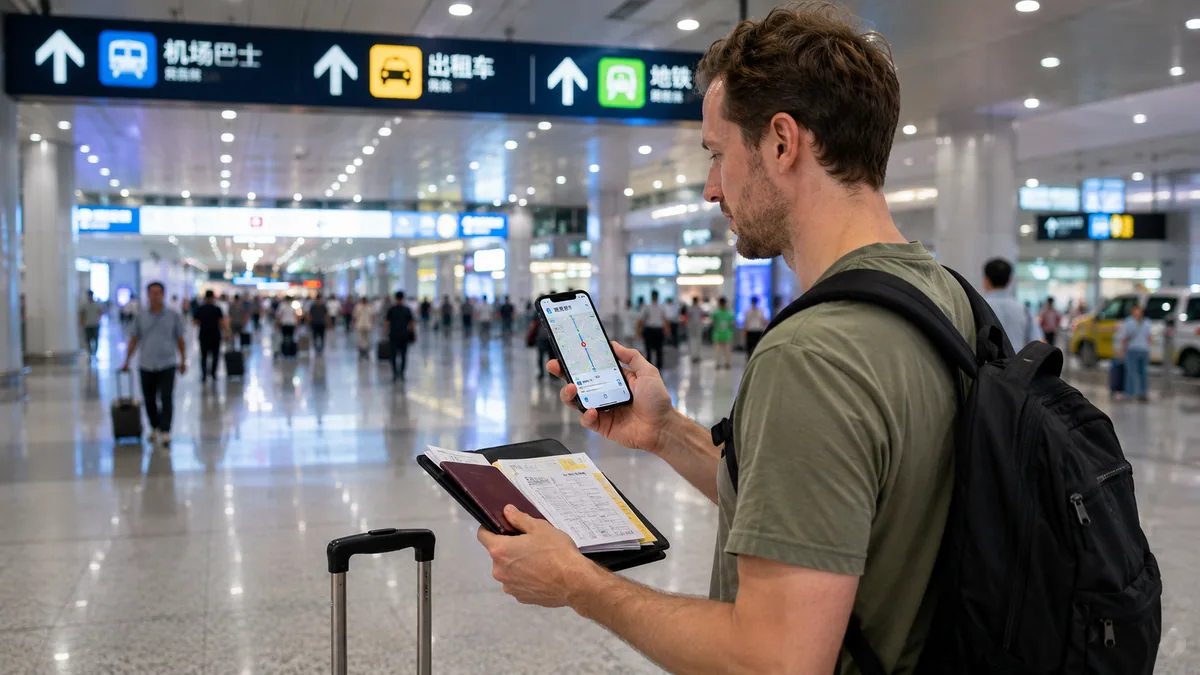
Make your first day simple. Know how you will get from airport or station to hotel, how you will pay, and what to show if a driver or staff member needs your address.
6. Backup plan
A good China travel plan includes backup. Keep screenshots of your hotel, passport page, entry document, first route, emergency contact, and payment fallback. This is not dramatic; it is just good travel hygiene.
The first-day folder
Create one offline folder on your phone before departure. Put your passport photo page, entry document if applicable, first hotel address in Chinese, booking confirmation, airport-to-hotel route, payment backup note, and travel insurance or emergency contact there. The folder should work even if you are tired and your internet is unstable.
| Need | Minimum preparation | Better preparation |
|---|---|---|
| Entry | Passport and current visa or visa-free check | Offline copies, official source links, airline confirmation if needed |
| Payment | One mobile wallet or card | Mobile wallet, backup card, cash, working internet |
| Arrival | Hotel booking | Chinese address, phone number, route screenshot, backup transport |
What you need for the first day
Your first day needs fewer things than your whole trip, but those things matter more. You need a way to prove who you are, a way to pay, a way to get online, a way to show your hotel address, and a way to ask for help if a tool fails.
Passport, entry document if applicable, and offline copies.
Mobile payment if available, physical card, and small cash backup.
Internet, map, hotel address in Chinese, and airport-to-hotel route.
Once these are ready, itinerary planning becomes much easier. You can still adjust cities, restaurants, and attractions later. But the arrival layer should be stable before you fly.
What you do not need to over-prepare
You do not need to plan every restaurant, every metro transfer, or every attraction detail before your first trip. China travel can be flexible once the foundations are ready. What you should not leave vague are entry status, payment, internet, first hotel, and first transport route.
This is the difference between useful preparation and anxious overplanning. The first group prevents real problems. The second group fills time but often does not help when you are standing in an airport with luggage.
Get the practical version
The free China Arrival Checklist turns this into a simple preparation list for your first trip.
Get the free checklist