Safety & First Arrival
Is China safe to visit for Americans?
Many Americans visit China without major problems, but “safe” is not a yes-or-no travel slogan. The practical answer depends on current official advisories, local rules, health preparation, payment access, internet access, and whether you have a fallback plan for your first 24 hours.

Start with official advice, then plan the practical layer
Before you travel, read the current U.S. State Department country page and travel advisory, then check health guidance from the CDC. These sources are not meant to plan your whole trip, but they help you understand current official risk language, entry considerations, health reminders, and emergency contacts.
The practical risks first-time visitors actually feel
| Risk | What it feels like | How to reduce it |
|---|---|---|
| Payment failure | A taxi, cafe, or small shop expects mobile payment and your card is not enough. | Set up Alipay or WeChat Pay before departure and carry a small cash backup. |
| No mobile data | You cannot translate, call a ride, open maps, or message your hotel after landing. | Prepare eSIM, roaming, or local SIM access before your arrival day. |
| Address confusion | Your hotel or destination name is only saved in English. | Save Chinese names, addresses, phone numbers, and screenshots offline. |
| Station and crowd stress | Large rail stations, security checks, and holiday travel feel harder than expected. | Build extra time into train days and avoid overpacked transfer plans. |
Respect local rules and avoid careless assumptions
A safe trip also means understanding that laws, app ecosystems, payment habits, internet access, and public behavior norms may not match what you are used to. Do not treat China as a place where you can improvise every digital task on arrival. Set up key tools while you still have your normal phone number, banking access, and time to troubleshoot.
Keep your passport secure, carry your hotel address, avoid arguments in high-friction situations, follow posted rules in stations and public places, and use official channels when a travel document or ticket issue appears.

Your first 24 hours are the safety test
The first day is where small preparation gaps become visible. A calm arrival plan should answer five questions: how will you get online, how will you pay, how will you show your hotel address, how will you reach the hotel, and what will you do if your first app or payment method fails?
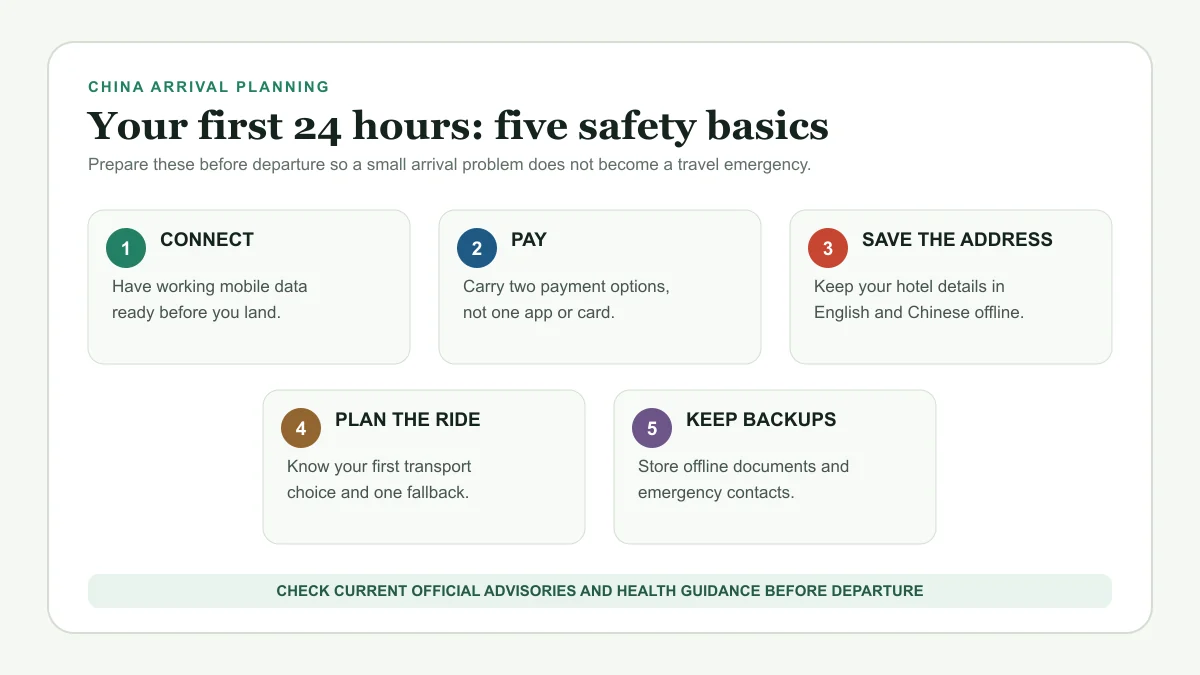
- Before landing, save your hotel name and address in Chinese and English.
- Keep an offline screenshot of your passport, hotel booking, and emergency contacts.
- Prepare at least two payment options, not just one app or one card.
- Know your first transport choice and one fallback.
- Do not schedule a tight train or domestic flight connection immediately after arrival.
Safety planning by traveler type
A safety plan should match the way you travel. The same checklist looks different for a solo traveler landing at night, a family managing several phones, and an older traveler who needs medication and slower transfer days.
| Traveler type | Main risk | Simple preparation |
|---|---|---|
| Solo traveler | Getting stuck without data, payment, or a clear hotel route. | Share your hotel address, arrival route, and first-day plan with someone before you fly. |
| Family trip | One phone or one payment app becoming the single point of failure. | Give at least two adults working data, payment access, hotel screenshots, and passport copies. |
| Older traveler | Medication, station walking distance, and slower recovery after long travel days. | Keep medication notes, insurance contacts, and extra station time in the plan. |
| Business traveler | Device access, meeting timing, payment friction, and hotel-to-office routing. | Save offline addresses, contact names, and a backup way to message your host or hotel. |
Digital and payment safety basics
Most avoidable stress comes from trying to set up essential tools after landing, when you are tired and dependent on airport Wi-Fi. Handle the important digital setup before departure while your bank, phone number, and email are easy to access.
- Use official app stores and official payment or airline channels; avoid random QR links from strangers.
- Do not rely on public Wi-Fi as your only internet plan.
- Carry a backup card and a small amount of cash even if you expect to use mobile payment.
- Save passport, hotel, insurance, and emergency contact information in more than one place.
- Keep Chinese hotel addresses and phone numbers as screenshots, not only live links.
Health and emergency preparation
Check health guidance before departure, bring prescriptions in original packaging where appropriate, and keep a short list of allergies, medications, insurance contacts, and emergency numbers. This is not exciting travel content, but it is exactly the type of preparation that makes unfamiliar systems feel manageable.
Bottom line
China can be a comfortable first trip if you prepare for the systems that are different: mobile payments, local apps, high-speed rail, language, maps, and official document requirements. The goal is not to be afraid. The goal is to remove the avoidable friction before you land.
Prepare the first-day safety basics.
Get the China Arrival Checklist for documents, internet, payment backup, apps, transport, and emergency fallback planning.
Download the checklist