For most first-time visitors, a 2-week China itinerary should be built around Beijing, Xi'an, Shanghai, and one optional extension such as Chengdu, Hangzhou, Suzhou, Guilin, or Zhangjiajie.
The biggest itinerary mistake is treating China like a small country with short city hops. Distances are large, stations can be big, and every hotel change costs energy. A good first route gives you variety without turning the trip into a logistics test.

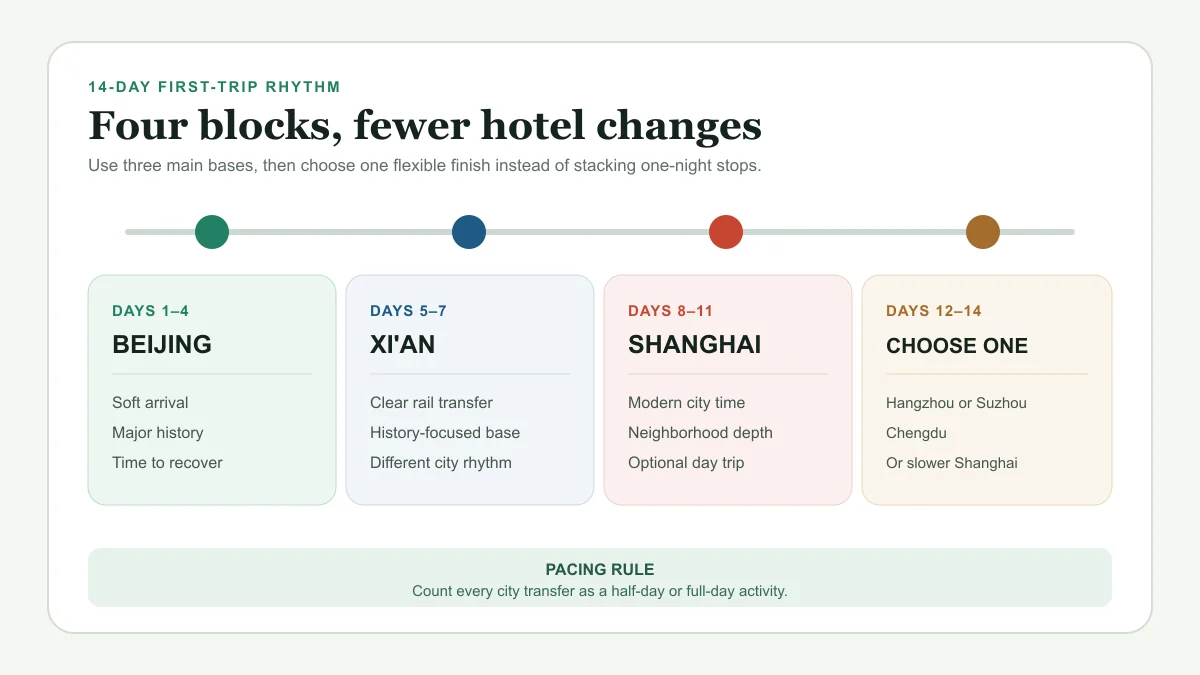
A realistic 14-day first China route
This route is not the only good plan. It is a stable first-timer structure: major history, a classic central stop, modern city time, and enough room to recover from arrival, weather, crowds, or app friction.
| Days | Base | Why it works |
|---|---|---|
| 1-4 | Beijing | Good international arrival city, major sights, and enough depth for a first-time visitor. |
| 5-7 | Xi'an | A strong history stop with a clear rail link from Beijing and a different city feel. |
| 8-11 | Shanghai | Modern city, food, neighborhoods, museums, and easy day-trip options. |
| 12-14 | Hangzhou, Suzhou, Chengdu, or slower Shanghai | Choose one extension based on interests instead of adding every famous place. |
Do not over-plan day one
Arrival day should be boring. Land, get connected, pass immigration and baggage, reach your hotel, eat something easy, and sleep. If you schedule a major sight on day one, you are betting against jet lag, delays, app setup, and navigation friction.
Airport to hotel, local meal, short walk, early night, payment and data check.
Airport transfer, hotel check-in, famous attraction, dinner reservation, and a late train.

How to treat rail days
A high-speed rail trip is often comfortable, but the whole day is not just the train ride. You need time to reach the station, go through checks, find the waiting area, board, arrive, leave the station, and check into the next hotel. That means a 4.5-hour train can still consume most of a travel day.
What to skip on a first 2-week trip
The hardest part of a China itinerary is not finding places to add. It is choosing what to leave out. A packed route looks exciting in a spreadsheet and exhausting in real life.
- Skip one-night city stops unless there is a clear reason.
- Skip distant nature destinations if the transport chain is unclear.
- Skip attractions that require difficult reservations if they are not a priority.
- Skip "just one more city" when it removes your recovery day.
Two good alternatives
| Route style | Use it if | Basic sequence |
|---|---|---|
| Classic first trip | You want history, big cities, and easy transport | Beijing -> Xi'an -> Shanghai -> Hangzhou or Suzhou |
| Food and slower pace | You care more about neighborhoods and daily life | Shanghai -> Hangzhou/Suzhou -> Chengdu -> Beijing or back to Shanghai |
Prepare the route before booking
Before you lock hotels, confirm your entry path, payment setup, internet plan, and rail booking method. These are not glamorous parts of the itinerary, but they decide whether the route feels smooth once you land.
Get the China Arrival Checklist
Use the starter checklist before you turn a 2-week route into booked hotels, rail tickets, and city plans.
Get the free checklist